Most spiders you find around a Las Vegas home are harmless. They eat crickets, flies, and other insects, and they would rather run than bite.
Two are worth recognizing on sight. Clark County Vector Control has said the only spiders people in the Las Vegas Valley need to be concerned about are the western black widow and the desert recluse, which locals often call the “desert brown.” This guide covers how to tell them apart from everything else, where they hide, and what actually keeps them away from your family.
What spiders live in Las Vegas?
Las Vegas spiders fall into two groups. A long list of hunting and web-building spiders, including wolf spiders, jumping spiders, cellar spiders, and tarantulas, which are nuisances at worst. And two species of real medical concern: the western black widow and the desert recluse. Knowing which group you are looking at settles most of the worry.
| Spider | How to recognize it | Where you find it | Medical concern |
|---|---|---|---|
| Western black widow (adult female) | Shiny black, about 1/2 inch body, round abdomen, red or orange hourglass on the underside | Block walls, garages, woodpiles, clutter, low to the ground | Yes. Seek medical advice after any bite |
| Desert recluse (“desert brown”) | Plain tan to brown, fragile-looking legs, 6 eyes in 3 pairs, violin mark faint or missing | Quiet, undisturbed storage: boxes, stored clothes, garage corners | Yes. Venom can damage skin |
| Tarantula | Large and hairy, 1 to 2 inch body | Outdoors, burrows; males wander in fall and spring | Low. Bite comparable to a bee sting |
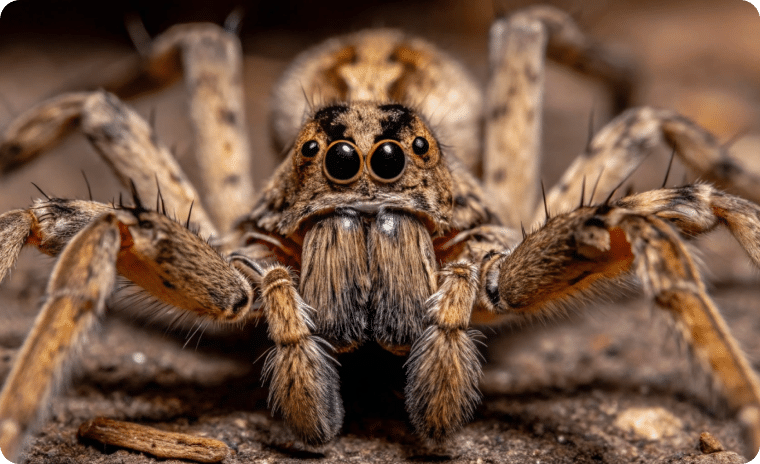
| Wolf spiders | Brown to tan, long hairy legs, eyes reflect green in a flashlight | Ground hunters; may wander indoors | Low |
| Jumping spiders | Compact, large front eyes, often iridescent | Walls, plants, windowsills in daylight | Low |
| Cellar spiders | Very long thin legs, look like daddy-longlegs | Ceiling corners, garages | Very low. Fangs rarely pierce skin |
| Yellow sac spider | Pale yellow, darker stripe on the abdomen | Ceiling corners, behind pictures; active at night | Low. Bite similar to a bee sting |
Spiders seen out in the open during the day are unlikely to bite, according to University of California IPM. The two that matter spend their days hidden.
Which spiders in Las Vegas are poisonous?
Strictly, spiders are venomous, not poisonous, but the question is the same. In the Las Vegas Valley, the two spiders of medical concern are the western black widow and the desert recluse. Both are shy and bite only when pressed against skin. Children, older adults, and people with weakened immune systems face the most risk from either one.
The two work differently:
- Black widow venom is a neurotoxin. It affects nerves and muscles rather than the skin around the bite. UC IPM calls the western black widow the spider posing the greatest potential envenomation threat to humans in the western United States.
- Desert recluse venom can kill skin tissue. UC IPM advises treating the desert recluse’s venom as equal in potency to the brown recluse’s. Clark County Vector Control has described it as similar but less severe.
The reassuring part: bites are rare. UC IPM notes that black widow bites are quite rare even where the spiders are very common, and that most people are bitten when they reach into a sheltered spot the spider was using.
If you think you or your child has been bitten, call Poison Control at 1-800-222-1222 or seek medical care. Do not wait for symptoms to develop. If you can safely trap the spider in a jar, bring it. An identified spider helps the person treating you.
How do you identify a black widow?
An adult female western black widow is shiny black all over, about 1/2 inch long, with a round abdomen and a red or orange hourglass on the underside. The catch is that young black widows and males look nothing like that, and the hourglass itself varies. Identify by body shape and web, not color alone.
The adult female
This is the one that matters. Only the adult female and larger immature females can bite through human skin and inject enough venom to cause a painful reaction. The hourglass can be two perfect triangles, two separated triangles, a triangle and a bar, a faint smudge, or occasionally missing altogether. Some well-fed females look brownish or plum-colored.
Immatures and males
Young black widows are tan with white and orange stripes and spots, and darken toward black as they molt. Adult males keep the striped juvenile pattern, are much smaller, and have fangs too small to break human skin. Plenty of Las Vegas homeowners see a striped spider in the garage and have no idea it is a young widow.
The web and egg sac
The web is the easiest giveaway. Black widows build an irregular, messy cobweb with tough, sticky silk that makes an audible ripping sound if you pull through a large one. Clark County Vector Control has pointed out that local black widows like to build on cinder block walls, where the webs look like clumps rather than neat patterns. Egg sacs are creamy yellow to tan, tough and papery, and about 1/2 inch across. A female can lay around 300 eggs per sac and produce more than 10 sacs from a single mating.
Is there a brown recluse in Las Vegas?
The brown recluse’s established range is the south-central Midwest, from southeastern Nebraska to southwestern Ohio and south through Texas to north Georgia. Nevada is not in it. Las Vegas does have a close relative, the desert recluse, a Mojave and Sonoran desert species whose venom UC IPM says should be treated as equally potent.
That distinction matters because almost every brown spider gets called a brown recluse. In a nationwide study from 2000 to 2005, nearly 600 spiders submitted from California as suspected brown recluses produced exactly one, which had arrived with a family moving from Missouri.
How to tell a recluse from everything else:
- Count the eyes. Recluses have 6 equal-sized eyes arranged in 3 pairs. Most spiders have 8. You need a good hand lens, and this single check rules out almost every look-alike.
- Ignore the violin. The violin marking is faint to missing on desert recluses, and people routinely “see” violins on harmless spiders.
- Look at the abdomen and legs. Recluse abdomens are uniformly colored with fine hair, never striped or spotted. Legs are thin with no stout spines.
Recluses also cluster. UC IPM puts it plainly: if you find recluses, you do not find one, you find many. A single tan spider in the laundry room is very unlikely to be a desert recluse.
Where do spiders hide around a Las Vegas home?
Black widows and desert recluses both choose dark, dry, undisturbed spots, usually within a few feet of the ground. Around a Las Vegas home, that means block walls, garages, stored boxes and clothing, patio furniture, and anything left sitting against the foundation. Bites usually happen when someone reaches into one of those spots without looking.
Check these places first:
- Block walls and the base of the house. Holes between blocks and gaps around pipe penetrations are ideal retreats for black widows.
- The garage. Black widows are common in garages, building webs by doors, near vents, and anywhere insects pass through. Both widow species are almost never found living inside the home itself.
- Stored clothing and boxes. Clark County Vector Control has flagged clothes stored in the garage as a likely place to meet a desert recluse, particularly during spring cleaning or when pulling out seasonal gear.
- Outdoor furniture and toys. Picnic tables, the grips of trash cans, lawn chairs, pots with curled rims, and molded plastic playhouses with downward-facing openings.
- Woodpiles, rock piles, and clutter near the foundation.
- Under outdoor lights. Lights draw insects, and insects draw spiders.
How do you get rid of spiders and keep them out?
Spider control is mostly housekeeping and exclusion, not spraying. University of California IPM says insecticides do not provide long-term control of spiders outdoors unless paired with removing webs and hiding places. The lasting fix is fewer places to hide, fewer insects to eat, and fewer gaps to get through.
What works, per UC IPM:
- Clear the foundation. Keep trash, leaf litter, heavy vegetation, and stored materials away from the walls of the house.
- Seal entry points. Caulk cracks in the foundation, gaps around windows and doors, and holes where conduit or plumbing enters, especially between an attached garage and the house.
- Store things sealed and off the floor. Use taped boxes or zip bags for garden gloves, boots, and seasonal clothing. Keep boxes away from walls.
- Vacuum webs and spiders. Their soft bodies usually do not survive a vacuum. A web with dust on it is abandoned.
- Redirect outdoor lighting away from doors and windows.
- Wear gloves when cleaning out the garage, moving wood, or reaching into storage.
Two honest caveats. First, black widow spiderlings travel on air currents by releasing silk threads, sometimes for miles, so new ones keep landing on your property. Control is ongoing, not one-and-done. Second, Clark County Vector Control has recommended against homeowners spraying pesticides for spiders, noting that some people react badly to them. Our article on DIY pest control vs professional covers why retail sprays tend to disappoint.
A professional treatment focuses on the same harborage points plus crack-and-crevice and wall-void applications that a homeowner cannot reach. [SWAT IT! TO CONFIRM: what a spider service visit includes, such as web sweeping, eave treatment, and follow-up.] See our spider control and extermination service for details.
When is a spider nothing to worry about, and when should you call?
Most spider sightings need a broom, not a professional. The line is simple: a single harmless spider in the open is normal in the desert. Repeated black widows, suspected recluses, or spiders around children’s play areas are worth a professional inspection.
| Probably fine to handle yourself | Worth a call |
|---|---|
| One wolf spider or jumping spider in the open during the day | Black widows on block walls or in the garage more than occasionally |
| Cellar spider webs in ceiling corners | Any spider you think might be a desert recluse, especially more than one |
| A tarantula crossing the yard in fall or spring | Widows around play equipment, patio furniture, or a pet’s bed |
| Old, dusty webs with no spider in them | Spiders returning within days after you clear webs |
| A few spiders after monsoon weather brings insects in | A heavy insect problem indoors, which is what spiders follow |
If you have pets or small children, our guide on whether pest control is safe for pets and kids covers what to ask before any treatment.
Frequently asked questions
Do black widows live inside Las Vegas houses?
Rarely. Black widows are common in garages and around the outside of homes, but UC IPM notes that widow spiders are almost never found living inside the home itself because there usually are not enough insects indoors to feed them.
Can a male black widow bite you?
A male black widow has venom, but its fangs are too small to break human skin. Only adult females and larger immature females can bite through skin and inject enough venom to cause a painful reaction.
Is the sore on my skin a spider bite?
Often it is not. Skin lesions are frequently blamed on spiders without proof. One national study found 29% of patients presenting with a “spider bite” actually had a MRSA infection. Several sores at once, or sores on several people in one house, point away from spiders. See a doctor for any wound that is spreading or getting worse.
Are tarantulas dangerous in Las Vegas?
No. Tarantula bites are generally comparable to a bee sting. Males wander in fall and spring looking for females, which is when most people see them. They are fragile and not interested in people, so the usual advice is to leave them alone.
Are brown widow spiders in Las Vegas?
We could not find published survey data for Nevada. In California, brown widows were established along the southern coast as of 2016 but not in desert areas, which may be too arid for them. Their bite is much milder than a black widow’s.
Will spraying kill black widow egg sacs?
Often not. Widow egg sac silk repels water, and a 2016 study found water-based insecticides had no significant effect on brown widow egg sacs. Removing the sacs by hand, with gloves, or vacuuming them is more reliable.
How do I get a spider identified?
Keep it as intact as possible. UC IPM recommends freezing the spider, then soaking it in rubbing alcohol for a few days to preserve it. Pour off the alcohol and rinse it before shipping, because mailing a specimen in alcohol breaks postal rules. Your local extension office can help.
Should I kill every spider I see?
Not necessarily. Clark County Vector Control and UC IPM both describe most spiders as beneficial because they eat pest insects. Remove black widows and suspected recluses, and consider leaving harmless hunters in the yard alone.