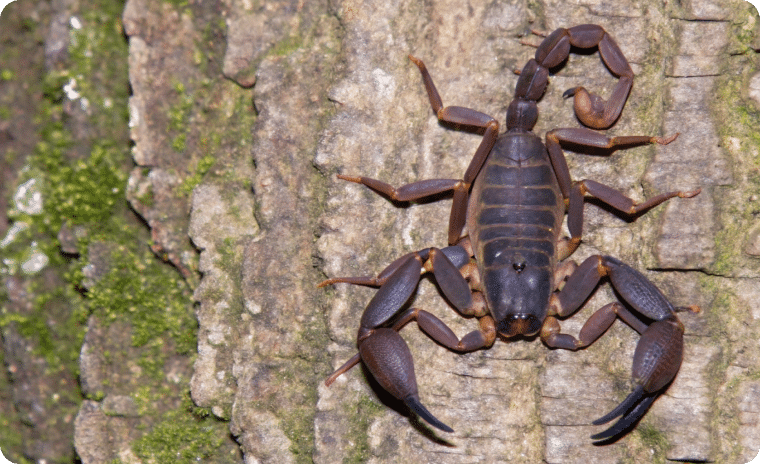
Nevada scorpions come in about 25 species, and most of them are no more dangerous than a bee. The one that matters in Las Vegas is the bark scorpion. It is small, light brown, climbs walls, lives in groups, and is the scorpion most likely to end up in your bathroom or your shoes.
If you found one tonight, the useful questions are what it is, how many more there are, and what keeps them out. Here are the straight answers.
What scorpions live in Nevada?
Nevada is home to about 25 scorpion species, according to Las Vegas Review-Journal reporting with a University of Nevada Cooperative Extension specialist. Most are burrowing desert scorpions that stay outdoors and sting about like a bee. The Arizona bark scorpion is the exception, and it is a common pest in the Las Vegas Valley.
| Bark scorpion | Burrowing desert scorpions | |
|---|---|---|
| Size | 1 to 3 inches | Varies by species; some desert species reach 5 to 7 inches |
| Color | Light brown to yellow, no stripes or pattern | Varies; some have stripes on the back |
| Tail | Very thin, about 1/16 inch wide | Thicker |
| Climbs walls | Yes. The only common climbing scorpion | Generally no. They dig burrows |
| Where it hides | Under bark, in palm trees, in wall cracks, attics, woodpiles | Burrows in soil, under rocks and debris |
| Lives alone or in groups | Groups | Typically alone |
| Sting | Can be serious, with nervous system effects | Usually similar to a bee or wasp sting |
Size and tail width sort out most sightings. A big, thick-tailed scorpion out in the yard is almost never the one to worry about. A slender, light brown one on a wall or ceiling usually is.
One more identification tip from the University of California IPM program: scorpions that hide under objects tend to carry the stinger to one side, while burrowing scorpions hold it up over the back. It is a quick field mark when you are looking at one on the floor.
Is the Arizona bark scorpion dangerous?
A bark scorpion sting can be serious. The UC IPM program lists severe pain and swelling, numbness, difficulty breathing, muscle twitching, and convulsions as possible effects, and says those symptoms call for immediate medical attention. Children, older adults, and pets face the highest risk. Deaths in the United States are rare.
M.L. Robinson of the University of Nevada Cooperative Extension told the Review-Journal that a bark scorpion sting can feel like a wasp or hornet sting, with the difference that the venom affects the nervous system. Other scorpions in the region usually cause intense local burning that fades in about 30 minutes, according to UC IPM.
The groups the Review-Journal named as most at risk:
- Children, especially those younger than 18 months
- Older adults
- Pets
- People allergic to bee stings
- People with existing medical conditions
If someone is stung, call Poison Control at 1-800-222-1222. The line is free and confidential. For anyone in a higher-risk group, or anyone with trouble breathing, twitching, or unusual eye or head movements, get emergency medical care right away. If you can capture the scorpion safely, bring it or a clear photo, because identification changes how the sting is handled.
This article is not medical advice. Poison Control and your doctor are.
When is scorpion season in Las Vegas?
Scorpion activity in Las Vegas climbs as the weather warms in late spring. Warm weather brings out the crickets and cockroaches scorpions eat. Robinson has described it as a perfect storm of food, water, and shelter around homes. A mild winter can mean more scorpions the following year, because more young scorpions and their prey survive.
Two things drive the seasonal pattern:
- Food. Scorpions eat insects, spiders, centipedes, and other scorpions. When crickets and roaches become active, scorpions follow.
- Heat. Scorpions are nocturnal. During triple-digit days they look for shelter, and a house is cooler and damper than open desert. A biology professor interviewed by the Review-Journal put it simply: why stay out in the heat when you can be inside?
Scorpions also grow and breed slowly. UC IPM notes they take 1 to 6 years to mature and may live 3 to 5 years on average. A population that builds up around a house does not disappear in a single season.
Why do scorpions get into Las Vegas homes?
Las Vegas yards give bark scorpions everything they need. Irrigation supplies water for them and their prey, landscaping and organic debris feed crickets and cockroaches, and the block walls around most homes are full of cracks to hide in. Bark scorpions climb stucco and block, and they need a gap only 1/16 inch wide to get inside.
Specific reasons they end up indoors:
- They climb. The bark scorpion is the only common climbing scorpion, so walls, stucco, and overhanging branches give it a route to eaves, vents, and the roof.
- Tiny entry points. UC IPM puts the gap at 1/16 inch. Robinson’s rule of thumb is simpler: if a credit card fits through a gap, so does a scorpion.
- Water. Bark scorpions are drawn to moisture, both around the house and inside it. That is why bathrooms, kitchens, and laundry rooms are common places to find them.
- Location. Neighborhoods on the edge of open desert tend to see more. The Review-Journal reported northwest valley residents near Ann Road and Durango Drive fighting scorpions for two straight years, including a family that moved to a hotel for a while.
- They hitch rides. Robinson has said bark scorpions are small enough to be carried in almost anything, including moving boxes.
Where did they come from? A common local theory is that bark scorpions arrived in palm trees shipped from Arizona. Robinson has pushed back on that, saying there is evidence of native bark scorpions in the area and that they are not necessarily an introduced species.
How do you find scorpions in your house and yard?
Use a black light. Scorpions glow under ultraviolet light, so wait until it has been dark for a while, then shine a UV flashlight along block walls, rocks, the base of the house, and around doors. Indoors, check cracks, baseboards, closets, attics, and anywhere damp. Seeing one usually means there are more.
Where to look:
- Outside at night: block walls, landscape rock, palm trunks, woodpiles, stacked bricks or lumber, and around outdoor lights
- Inside: bathrooms and kitchens, behind baseboards, in closets, attics, and cracks in woodwork
- In things you touch: shoes, boots, towels, and clothing left on the floor or outdoors
The group behavior matters here. Bark scorpions live in groups, unlike most scorpions that live alone. One biology professor told the Review-Journal that for every scorpion you see, six or seven more may be hiding nearby. Treat that as a warning to look harder, not a precise count.
If you need to remove one, UC IPM suggests placing a glass jar over it, sliding heavy paper underneath, and flipping the jar, or using forceps 10 to 12 inches long. Do not pick one up by hand.
How do you get rid of scorpions in Las Vegas?
Start with exclusion and yard cleanup, not spray. Seal gaps around doors, windows, pipes, and eaves, clear debris away from the foundation, and cut back branches that touch the house. UC IPM says scorpions are hard to control with insecticides because they hide in cracks during the day, and adults have a thick outer shell.
Seal the house:
- Weatherstrip loose doors and windows
- Caulk around roof eaves, pipes, and other cracks
- Keep window screens tight and in good repair
- Check the gap under each exterior door with the credit card test
Take away shelter and food:
- Remove trash, boards, logs, stones, and bricks from around the foundation
- Keep firewood outside and check each piece before bringing it in
- Prune branches that touch the roof or walls
- Switch outdoor bulbs to yellow lights, which attract fewer of the insects scorpions hunt
Change habits:
- Shake out shoes, clothing, and pool towels before using them
- Do not leave shoes or wet towels outside
- Wear gloves for yard work and shoes outdoors in the evening
Robinson has also suggested glue traps placed near openings to catch scorpions and the insects they eat. Glue traps are a monitoring tool as much as a control tool. Where they catch scorpions tells you where they are getting in.
About sprays: UC IPM warns against overusing pesticides out of frustration. A spray only works on a scorpion that walks through it, and most of the population is hiding in walls and rock. For more on why store-bought sprays fall short, read DIY Pest Control vs Professional: The Dangers of Retail Sprays. If you have pets, Is Pest Control Safe for Pets and Kids? covers what to ask before any treatment.
When should you call a pest control company for scorpions?
Call when scorpions keep showing up indoors, when you live with small children, older adults, or pets, or when you find several in one night. Sealing and cleanup reduce scorpions, but a population that has settled into block walls and landscape rock usually needs inspection and treatment placed where they actually live.
You can probably handle it yourself when:
- You found one scorpion outdoors, in the yard or on a wall
- It is a large, thick-tailed burrowing scorpion, not a bark scorpion
- You have not seen one indoors in months
- You are sealing gaps and clearing debris and sightings are dropping
Call a professional when:
- You find bark scorpions inside, especially in bedrooms or bathrooms
- Someone in the home is under 18 months old, elderly, or has a medical condition
- You have pets that roam the yard at night
- A black light check turns up several scorpions on your walls
- Your neighbors are dealing with them too
- You have sprayed more than once and they keep coming back
Questions to ask any scorpion control company:
- Is your company and the technician licensed by the Nevada Department of Agriculture?
- Will you inspect with a black light at night, or only during the day?
- What exclusion work is included, and what will you recommend I seal myself?
- Where exactly will product go: block walls, landscape rock, eaves, wall voids?
- How long before I should see fewer scorpions, and what happens if I don’t?
- What do I need to do with pets and children during and after treatment?
- Is this a one-time visit or a recurring plan, and why?
Any company that answers these clearly, including us, is worth considering. Our approach is on the Scorpion Control & Extermination page, and service coverage is on Las Vegas Pest Control.
Scorpions are one of several desert pests Las Vegas homeowners deal with. For the rest, see The Most Common Bugs in Las Vegas.
Frequently asked questions
Are scorpions insects?
No. Scorpions are arachnids, in the same class as spiders, ticks, and mites. They have four pairs of legs, a pair of pincers, and a segmented tail that ends in a stinger. Insects have three pairs of legs.
What do scorpions eat?
Scorpions eat insects, spiders, centipedes, and other scorpions. Large scorpions occasionally eat small lizards, snakes, and mice. Around Las Vegas homes, crickets and cockroaches are a main food source, which is why controlling those insects also helps with scorpions.
Are scorpions good for anything?
Yes. Scorpions eat insects and other arachnids smaller than themselves, including crickets and cockroaches. A University of Nevada Cooperative Extension specialist has called them beneficial for that reason. The problem is only when bark scorpions move into or onto the house.
How many babies does a scorpion have?
A single female may produce 25 to 35 young, according to UC IPM. Scorpions are born live, and the young ride on their mother’s back until their first molt. That is one reason a few scorpions around a house can become many.
Can a scorpion sting more than once?
A scorpion can sting repeatedly, but it does not always use venom. UC IPM notes that when a scorpion can overpower prey without venom it will, and that venom can take up to two weeks to regenerate. Treat every sting from a bark scorpion as a real sting.
Do chickens eat scorpions?
Yes. A University of Nevada Cooperative Extension specialist mentioned backyard chickens as one way people reduce scorpions, because chickens eat them. Chickens will not reach scorpions hiding inside walls or the house, so they are a supplement to sealing, not a replacement.
Are scorpions a risk to dogs and cats?
Pets are among the groups most at risk from bark scorpion stings, according to Las Vegas Review-Journal reporting. If your pet is stung, or you see sudden pain, drooling, or trembling after it has been in the yard, call your veterinarian or an emergency animal hospital.
Should I kill scorpions or relocate them?
That is a personal choice. Some extension specialists relocate scorpions because they eat pest insects. If a scorpion is inside your home and you have children or pets, removing or killing it is reasonable. Use a jar or long forceps, never your hands.
The bottom line
Nevada has plenty of scorpions, but only one that should change how you live in your house. The bark scorpion climbs, hides in groups, fits through a 1/16 inch gap, and has the sting that sends people to the doctor.
Most scorpion problems in Las Vegas come down to gaps and shelter. Close the gaps, clear the shelter, and keep checking with a black light. If they keep coming inside, the population is living somewhere you can’t reach.
What to do next:
- Do a black light check along your block walls and foundation an hour after dark
- Run the credit card test on every exterior door and seal what fails
- Move rocks, boards, and firewood away from the foundation
- Shake out shoes, towels, and clothing, especially in summer
- Save Poison Control, 1-800-222-1222, in your phone
- Switch outdoor lights to yellow bulbs
- If you find bark scorpions indoors, request a quote and tell us where and how many