Yes, there are roof rats in Las Vegas. They have lived across the valley since at least 1990. Seeing one on your block wall does not mean your neighborhood is overrun. It does mean the rat has food, water, and cover nearby, and if it can reach your roofline, your attic is next on its list.
This guide covers how to confirm you have roof rats and not something else, why Las Vegas yards attract them, what the health district says about disease risk, and how to get them out and keep them out.
Are roof rats a problem in Las Vegas?
Roof rats are established in the Las Vegas Valley but not everywhere at once. The Southern Nevada Health District has documented them since 1990, first in the south-central valley and tied to imported palm trees. Reports cluster near washes, heavy vegetation, and standing water. Norway rat activity in the valley has been rare.
So the honest answer to “is it bad?” is: it depends on your block. Health officials have described past outbreaks as sporadic colonies rather than a valley-wide infestation. A 2004 Las Vegas Sun report described colonies in the Scotch 80s and Spanish Trail, both neighborhoods with mature landscaping.
More recent reporting points to growth. In November 2024, FOX5 Las Vegas visited a block near the 215 Beltway and Windmill Lane where several homes had spotted rats or called pest control. A pest control operator interviewed for that story said the block wall behind the homes worked as the rats’ “highway,” and that his calls peak between Thanksgiving and Christmas, when cold snaps and open patio doors bring rats inside.
A clear rule of thumb comes from a Clark County environmental health supervisor quoted in 2004: roof rats are nocturnal, so if you are seeing a significant number of them in daylight, the population is already large.
How do you tell a roof rat from a Norway rat?
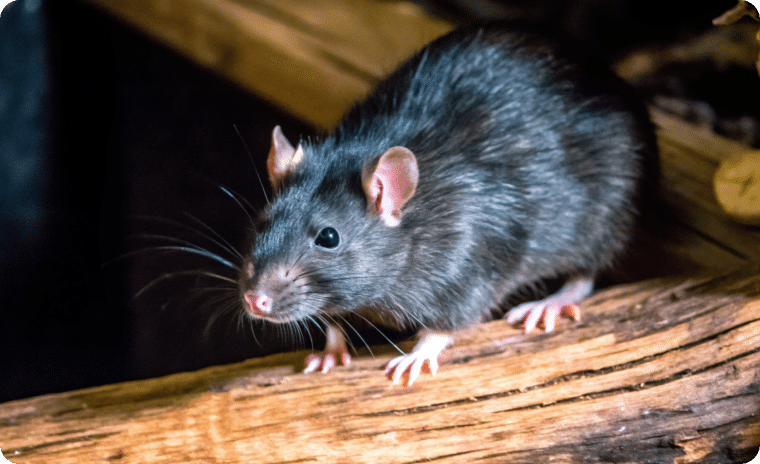
Check the tail. A roof rat’s tail is longer than its head and body combined, and it has large ears and a pointed snout. A Norway rat is heavier, with a blunt nose, small ears, and a tail shorter than its body. In Las Vegas, the rat you see is almost always a roof rat.
| Roof rat (Rattus rattus) | Norway rat (Rattus norvegicus) | |
|---|---|---|
| Weight | 5 to 10 ounces | 12 to 16 ounces |
| Total length | 10 to 14 inches | 13 to 18 inches |
| Tail | Longer than head and body | Shorter than head and body |
| Ears and nose | Large ears, pointed snout | Small ears, blunt nose |
| Where it nests | Up high: trees, dense shrubs, attics, wall voids | Down low: burrows along foundations, under woodpiles |
| Preferred food | Fruit, nuts, seeds, vegetables | Grains, meat, food waste |
| How common in Las Vegas | Documented across the valley since 1990 | Rare, per the health district |
Weights and lengths: Southern Nevada Health District. Nesting and diet: Southern Nevada Health District and UC IPM.
Nest location matters most for control. Roof rats live above ground, so traps and bait on the garage floor miss them. UC IPM’s guidance is to set traps for roof rats on ledges, fence tops, pipes, branches, and beams.
One more look-alike: pack rats, also called woodrats, are native to the desert Southwest. Their tails are furry. Roof rat tails are scaly and nearly hairless.
Why do roof rats move into Las Vegas yards?
Roof rats need water, food, and cover above ground. Irrigated Las Vegas yards provide all three: sprinklers and drip lines, citrus and other fruit trees, palms and dense shrubs, and block walls that work as travel routes. The health district ties most reports to areas near washes, heavy vegetation, and standing water.
The desert itself is not good roof rat habitat. The Las Vegas Sun reported in 2004 that roof rats arrived in Southern Nevada mostly in shipments of palm and fruit trees. A county environmental health supervisor told the paper that “these animals cannot survive without a lot of water.”
Once they are here, the typical Las Vegas lot makes it easy for them:
- Fruit trees. Roof rats prefer fruit and nuts. UC IPM notes they often hollow out oranges on the tree through a small hole, leaving the rind hanging.
- Palms and dense shrubs. Dead palm fronds and thick hedges give them nesting cover off the ground.
- Block walls and utility lines. A county vector control officer described roof rats walking along the tops of block walls and electrical wires.
- Pet food and grills. Food left outside overnight and dirty barbecue grills draw rats in, according to the 2024 FOX5 report.
- Irrigation. Water is the one resource the desert withholds, and sprinklers, fountains, and pool equipment supply it.
Roof rats also breed fast. The health district says they reach maturity in 2 to 3 months and can have 4 to 6 litters a year, with 4 to 8 pups per litter.
What are the signs of roof rats in your house or yard?
The most common signs are droppings near pet food or in the garage, fruit hollowed out while still on the tree, rats running along block walls or utility lines at dusk, gnawed wiring or wood, dark smudge marks on beams and pipes, and scratching in the attic or walls at night.
Signs to check outside:
- Citrus rinds hollowed out on the tree, or fallen fruit with gnaw marks
- Droppings around pet bowls, pet food bins, or under the grill
- Rats on fence tops or overhead lines at dusk or shortly after
- Dense nesting material in palm skirts or thick shrubs
Signs to check inside:
- Scratching or running sounds in the attic, walls, or false ceilings at night
- Droppings in cabinets, the attic, or the garage
- Gnawed wiring, trim, or door edges
- Greasy smudge marks where rats rub along beams, rafters, and pipes
- Shredded insulation, which rats use for nests
UC IPM notes that rats gnaw wiring in attics and in car engines. Attic gnawing can cause electrical sparks and fire hazards, which is the strongest reason not to wait.
Are roof rats dangerous to your health?
They can be. The Southern Nevada Health District says roof rats and their parasites can transmit plague, typhus, salmonella, leptospirosis, rat bite fever, and other diseases. Their droppings, urine, and hair can contaminate large areas. That is a statement of potential risk, not a report of local outbreaks.
On the local testing record: the Las Vegas Sun reported in 2004 that more than 1,100 rats trapped and tested in Clark County since 1993 had produced no roof rats positive for plague or hantavirus. Some native desert woodrats had tested positive for plague. That data is two decades old, so treat it as history, not a current all-clear. The health district runs an ongoing rodent surveillance program, described on its zoonotic diseases page.
The practical risks for most households are contamination of food and pet food, damage to wiring and insulation, and the chance of a bite if a rat is cornered or handled. UC IPM advises wearing disposable gloves to handle dead rodents and traps, and never touching them bare-handed.
How do you keep roof rats out of your house?
Exclusion is the long-term fix. Seal openings larger than 1/4 inch with steel wool, wire mesh, or sheet metal. Cut tree limbs back from the roof, remove climbing vines, secure pet doors at night, and take away food and clutter. Rats chew through plastic, foam, wood, and caulk.
This checklist combines the Southern Nevada Health District’s rodent control measures with UC IPM’s detailed specifications:
Seal the structure
- [ ] Seal openings larger than 1/4 inch, including pipe chases and wire entry gaps, with steel wool, aluminum, or wire mesh
- [ ] Weatherproof windows and doors; if you can see daylight around a closed door, a rat can find the gap (young rats fit under a 1/2-inch gap)
- [ ] Cover vents with 1/2-inch galvanized metal mesh, never chicken wire
- [ ] Screen rooftop plumbing vents more than 2 inches in diameter
- [ ] Secure pet doors at night
Remove the ladders
- [ ] Cut back tree limbs near the roof (UC IPM’s detailed guidance says within 6 feet)
- [ ] Remove or thin vines and climbing plants on walls and fences
- [ ] Keep bushes trimmed, with space between shrubs and the house
Remove food and cover
- [ ] Do not leave pet food outside overnight
- [ ] Pick up fallen fruit and nuts
- [ ] Keep trash cans covered, and do not put food garbage out in bare plastic bags
- [ ] Clear clutter, brush, leaf litter, and landscaping debris quickly
- [ ] Stack firewood 12 inches off the ground
Roof rats go back to their nest sites. UC IPM notes they have strong nest-site loyalty, so trimming a palm skirt or clearing a hedge they nest in matters as much as sealing the house.
Can you get rid of roof rats yourself?
Sometimes. After rodent-proofing, snap traps set above ground can handle a small problem. The Southern Nevada Health District recommends that rodent control be done by a company licensed by the Nevada Department of Agriculture, and says over-the-counter poison baits should not be used in homes with children or pets unless a licensed company directs it.
Roof rats make DIY harder than people expect. UC IPM notes that rats avoid new objects for days or weeks, and that this wariness is stronger in roof rats. A trap that snaps and misses can leave a rat that avoids traps from then on. UC IPM’s guidance is to leave traps baited but unset until rats are taking the bait, and to use enough of them, often a dozen or more in a heavy infestation, spaced 10 to 20 feet apart.
Baiting carries its own risk. UC IPM warns that all rodenticides are toxic to pets and people, that dead rats can carry enough bait to poison a dog or cat that eats them, and that you should seal the house before baiting outside so poisoned rats do not die in your walls. For more on how treatments affect animals at home, see Is Pest Control Safe for Pets and Kids? An Honest Answer.
Handling it yourself is reasonable when:
- You have seen one or two rats outside and none indoors
- There are no children or pets who could reach traps or bait
- You can reach the roofline and seal openings safely
- You are prepared to set traps above ground and check them daily
Call a licensed company when:
- You hear rats in the attic or walls, or find droppings indoors
- You see rats in daylight, which suggests a large population
- There is gnawed wiring in the attic or your car
- You have kids or pets and want to avoid bait inside the home
- Traps have caught rats for more than a couple of weeks and activity has not stopped
If you have already tried store-bought products, DIY Pest Control vs Professional: The Dangers of Retail Sprays covers where home treatments tend to fall short. Our rodent control and extermination service starts with [an inspection of the roofline, attic, and yard to find entry points and nest sites]. [SWAT IT! TO CONFIRM: what the rodent service includes, trapping vs baiting approach, and follow-up schedule.]
Frequently asked questions
When are roof rats most active in Las Vegas?
Roof rats are active year-round and mostly at night. February and March are peak breeding months, according to a 2004 Las Vegas Sun report. A local pest control operator told FOX5 in 2024 that indoor calls peak from Thanksgiving to Christmas, when cold snaps push rats toward warm houses.
Are pack rats the same as roof rats?
No. Pack rats, or woodrats, are native to the desert Southwest, and their tails are covered in fur. Roof rats are an introduced species with scaly, nearly hairless tails that are longer than their bodies.
Do roof rats carry rabies?
According to UC IPM, commensal rats such as roof rats and Norway rats do not carry or transmit rabies. They can transmit other diseases, which is why droppings and dead rats should be handled with gloves.
Can roof rats chew through car wires?
Yes. UC IPM reports that rats commonly gnaw the insulation on engine wiring, which can cause significant malfunctions. A weighted car cover that touches the ground on all sides can discourage them, but controlling rats around the property is the longer-term fix.
Do ultrasonic rat repellers work?
Not for long. UC IPM says rats quickly get used to repeated sounds, which makes high-frequency and ultrasonic devices ineffective in homes and gardens. It also reports that no repellent has solved a rat problem for more than a very short time.
Will a cat get rid of roof rats?
Usually not. UC IPM notes that predators cannot keep up with animals that breed as fast as rats do. Feeding a cat outdoors can make things worse, because the cat food becomes a steady food source for rats.
Should I live-trap and release a roof rat?
UC IPM does not recommend it for homeowners. Roof rats are not native to the United States, a released rat can harm local wildlife, and it remains a health concern for you and your neighbors.
Will the Southern Nevada Health District remove rats from my property?
The health district’s rodent page recommends that rodent control be done by a pest control company licensed by the Nevada Department of Agriculture. The district runs a rodent surveillance program and can be reached at (702) 759-0588.
How fast can a roof rat problem grow?
Quickly. The Southern Nevada Health District says roof rats mature in 2 to 3 months and can have 4 to 6 litters a year of 4 to 8 pups each, so a few rats with good habitat can become a colony within a season.
The bottom line
Roof rats are a real but uneven problem in Las Vegas. They follow water, fruit, and dense landscaping, and they get into homes by climbing. The fix that lasts is exclusion: seal openings, cut back the ladders, and remove the food. Traps and bait handle the rats already there.
What to do next:
- Walk your yard at dusk and check block walls, fence tops, and fruit trees for activity
- Look for hollowed fruit, droppings near pet food, and smudge marks in the garage
- Seal any opening larger than 1/4 inch and screen vents with 1/2-inch galvanized mesh
- Cut back limbs and vines touching the roof and bring pet food in at night
- If you hear rats in the attic or see them in daylight, schedule a rodent inspection
- Read the most common bugs in Las Vegas to see what else irrigated yards attract
- Find out more about pest control in Las Vegas and the neighborhoods we serve